
(Trouser Press Books, 2025)

Generally speaking, I have always liked to have something to read on my bedside table, with a preference for biographies, whether of politicians or artists. Of course, a book about Michael Jackson might catch my attention, but my knowledge and interest in the character now encourage me to be selective in order to find relevant content about a person who has been written about so much over so many years, to avoid literary indigestion, and after so many biographies so basic that they might seem repetitive have been published.
Fortunately, some publications related to the King of Pop stand out with an interesting concept that I know I will enjoy, as it was the case with Dan Beck’s You’ve Got Michael, published in the fall of 2025.
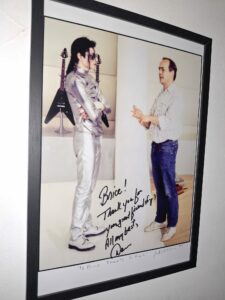
The author of this book was not unknown to me, having had the opportunity to meet him in London in 2016, during the second edition of Kingvention. I was able to learn about his collaboration with Michael Jackson at Sony Music as Marketing & Sales Director. It was an area I knew nothing about, which sparked my interest to the point that I asked him for an interview for my website the following year. Eager to learn about the vast world of Jackson, I discovered another facet of his life and developed my thinking on the subject. I was therefore delighted to hear about this new publication, knowing that the book would inevitably offer me a comprehensive and detailed account of this collaboration, going far beyond the information I had gathered at Kingvention and for my website, especially since my affection for the HIStory album was bound to come into play in the year of its 30th anniversary. It must be said that, to my great regret, no celebration worthy of the name was held, so I couldn’t resist crossing the Atlantic Ocean at the end of October for a Kingvention in New York. The event was to take place at the Hit Factory studios, where part of the HIStory album was recorded. After the Mountains Studios in Montreux and Westlake in Los Angeles, I once again wanted to visit a place where the King of Pop recorded his music. That argument was unbeatable, but the fact that Dan Beck was coming to present and sign copies of You’ve Got Michael in advance was one of the (many) reasons that encouraged me to make the trip.
Once I had met the author and had my book signed, I was in the perfect frame of mind to immerse myself in this rich and powerful account. This is Dan Beck’s first book, a sign that his collaboration with the King of Pop remains his most memorable. Taking the step of writing a book is always a powerful moment of reflection that demonstrates the need to externalize an experience that has left a mark on you. The author does not forget to introduce himself and tells about his career path, which took him from music journalism to advertising for the CBS record label in the 1970s, and his first collaboration with the Jackson brothers in 1975-76. Dan Beck then recounts his evolution into the 1980s as a product manager, promoting albums by various artists such as Luther Vandross, Cyndi Lauper, and Sade. This immerses the reader in the musical context of the time within the framework of a record label. It’s a kind of behind-the-scenes immersion in a world we never suspected existed when we listened to our audio cassettes back then. It’s all very informative, and as we discover the organizational chart stretching from Epic Records to its parent company CBS, we can reminisce about a bygone era – a time when artists and their record labels earned most of their income from album sales, with the compact disc about to replace vinyl records. In these early chapters related to the 1980s, and long before working directly with Michael Jackson, Dan Beck shares his perspective on the man who was already the biggest artist in the music industry. This is an opportunity to salute the work of Franck DiLeo, another executive at Epic who was instrumental in promoting the Thriller album and later became the star’s manager. We can already sense Dan Beck’s determination to climb the ladder and his long-term commitment, not to mention the hours of work, which enabled him to advance in his career, sometimes at the expense of his personal life.
The 1990s arrived, and it could even be said that Dan Beck reached a turning point in his career with his new role as marketing director. It should be remembered that at the time, CBS was bought by Sony and Michael Jackson was about to release his Dangerous album without Quincy Jones, his iconic producer from the previous decade. It was in this context that Dave Glew, president of Epic Records, visited Beck to announce the words “You’ve Got Michael,” which would completely change his daily life.
Among all those insignificant moments that have been forgotten, we inevitably remember the defining moments that have had an impact on the course of our lives. The author’s choice to immortalize this brief moment as the title of his book expresses how much his career reached a turning point in this long process of promoting the work of artists. Through his collaboration with the King of Pop, which began just as the Dangerous album was about to be released, Dan Beck tells us how exciting the challenge was. He can thus be considered a mountaineer who wanted to take on Everest, and he gives us a sincere account without trying to sugarcoat reality. In his new role, he did not hesitate to seek advice from his superiors, including Larry Stessel, who had held the position before him. He also explains some important mechanisms, such as good communication with the artist’s inner circle, notably his lawyer John Branca and his manager Sandy Gallin. This decision-making role in choosing singles and shooting music videos with their respective budgets allows us to revisit our own memories as fans. Many of us bought these records and were happy to discover a new music video on television. All these choices were made with Michael Jackson’s approval, and we read the conversations between him and the author with great interest. For example, I really enjoyed discovering the behind-the-scenes story of the “Jam” video and how much effort it took to make the brilliant idea of including Michael Jordan in the project happen. Other highlights of the Dangerous era, such as the Super Bowl, the Grammys, and the interview with Oprah, are of course covered. Throughout the story, we feel the author’s determination to reconquer the American charts. As a European, this is not something I felt at the time, but I enjoyed fully experiencing this aspect of MJ’s career on his native soil. In this quest, the author also reveals unfinished projects such as a film shot during a charity day organized at Neverland, and the release of the Dangerous The Shorts Films video cassette, which took fourteen months to edit due to the star’s perfectionism. We can feel the King of Pop’s enthusiasm for this project and how much he increasingly valued the author, as he was aware that the latter wanted to promote his music and restore his public image. Throughout these pages, we realize how working for Michael Jackson was truly something special.
The 1993 case is, of course, discussed, and the author reveals the consequences for marketing and legal aspects, while also sharing his personal experience of the event. This book is not based solely on figures and financial aspects, and Dan Beck’s personal reflections and the human aspect are an integral part of the narrative and further legitimize this publication.
As the chapters go by, I can feel that the book builds momentum and that the pages related to the HIStory album are the climax of the story. From a best-of project with a few unreleased tracks that would become a double album, Dan Beck had the complex role of acting as a liaison between the artist and his record label for numerous negotiations. Between the pressure from his company to finalize the album and all the goodwill shown to his artist so that he could express his art in the best possible conditions, we are fully immersed in the atmosphere of the time. For this title, HIStory, brilliantly conceived by the author, Michael Jackson imagined the concept of the statue and its teaser. It’s no secret that this is my favorite album, and when I was 16, I couldn’t help but embrace this concept, delighted that I was by the return of my favorite star in response to the lawsuits. More than thirty years later, reading this book, I can see that it wasn’t necessarily easy to promote and get as many people as possible to embrace this concept, even though it was the biggest advertising campaign ever undertaken by a record label. We can feel Dan Beck’s kindness towards the artist, reminding us of MJ’s enthusiasm, his passion for his art, and how grateful he was for everyone’s work, while acknowledging a certain stubbornness in his decisions. The author, always very professional, does not try to make him out to be his friend, but simply gives us a beautiful description of what Michael Jackson was like as a person at work. Beck also does not hide the difficulties faced with a very negative press in the US and how much it took to support the HIStory project. The controversy surrounding the lyrics of “They Don’t Care About Us”, and the anecdote of MJ’s return to the studio to make a new version remain highlights of this account as it was not easy to negotiate with the man himself, who saw it as a terrible injustice. Throughout it all, Dan Beck defended his artist and his interests for his own good, but the risk was that the artist would become isolated and feel misunderstood by everyone. Above all, it was the gap between the star and his native country that was widening. That’s why it was appropriate to put the music back in the spotlight, as the author had always wanted. The two HBO One Night Only concerts scheduled for December 1995 at the Beacon Theater in New York were a step in that direction. Unfortunately, MJ’s discomfort during rehearsals and the cancellation of the concerts marked a terrible setback. We sense immense dismay in Beck’s account, as if the promotion of the album had stopped in the US. The decision to start the HIStory Tour in Eastern Europe and Asia the following year was in line with this. It was at this point that Dan Beck left Epic Records to launch the record label V2 Records with Richard Branson. I dare to ask myself a question, which is my own personal opinion: if Dan Beck had stayed, would the gap between Michael Jackson and Sony have widened so much?
Through each anecdote, I thought back to how I had experienced the event, whether it was a television performance or the release of a music video, taking me back to when I was 16. This book is really very informative. For example, I finally understood why Michael wore angel wings in the “You Are Not Alone” music video when the video cassette was released, and not during his previous television appearances.
I can only recommend this book, even though I was slower to read it in English as I would have been in French. No doubt I would have devoured it much more quickly if it was translated. In this day and age when physical media is increasingly being replaced by digital, and with which I identify myself less and less, I can only applaud this initiative. Any testimony from a Michael Jackson collaborator is precious and must be immortalized to continue celebrating his legacy.
Thanks to Dan Beck, Steven Paul Whitsitt and the Kingvention team.


Interview with Dan Beck (2017)