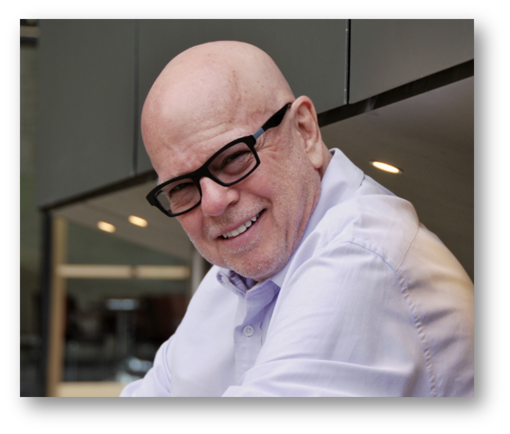
Even though I am well aware that this “tribute” category can only grow larger over the years, it is nonetheless difficult to write these lines—especially when they concern Tom Bähler. Here is a person who meant a great deal to my journey as an author. In this passion for Michael Jackson that I wished to share through his collaborators, Tom was one of the pioneers; his support encouraged me immensely on this path. His was a name I often saw in Michael Jackson’s album credits, and he completely deserved to have his life’s work recognized.
It must be said that when I joined Facebook in August 2009, this musician was one of the first people to whom I sent a friend request. It wasn’t that I expected much from such outreach at the time, but it was an integral part of the grieving process following the death of the King of Pop. I remember his first comment on a photo of Michael and Siedah Garrett during a session for “I Just Can’t Stop Loving You,” telling me that he had known them both at the very start of their careers. I felt all the kindness and accessibility that social media can offer, and undoubtedly a form of encouragement to pursue this path of sharing stories with the collaborators of the Jackson universe. These reflections continued to mature in my mind until I launched into writing projects a few years later. During this journey, I had also begun working with a web radio station at the time, Michaelizer, and thus completed my first interview with Tom Bähler regarding the track “Ease On Down The Road.” He had co-produced this duet between MJ and Diana Ross with his friend Quincy Jones for The Wiz soundtrack. From that session, I remembered the anecdote of Diana being unhappy with Quincy’s absence, especially since she didn’t know the person she was speaking with that day. The fact that the leader of the Jacksons stepped in to defend him, saying he had known Bähler for years and that everything would be fine, demonstrates the respect and closeness they shared—especially considering the affection Michael held for his Motown godmother. Indeed, it was at Berry Gordy’s label that Tom Bähler, along with his brother John, first began collaborating with the future King of Pop as a vocal arranger in the early 70s. He was perhaps the longest-standing collaborator, as their work continued into the 2000s; one can easily cite his work as a choir director on tracks like “The Lost Children” for the Invincible album and “People Of The World,” which Jackson gifted to the Japanese group J-Friends.
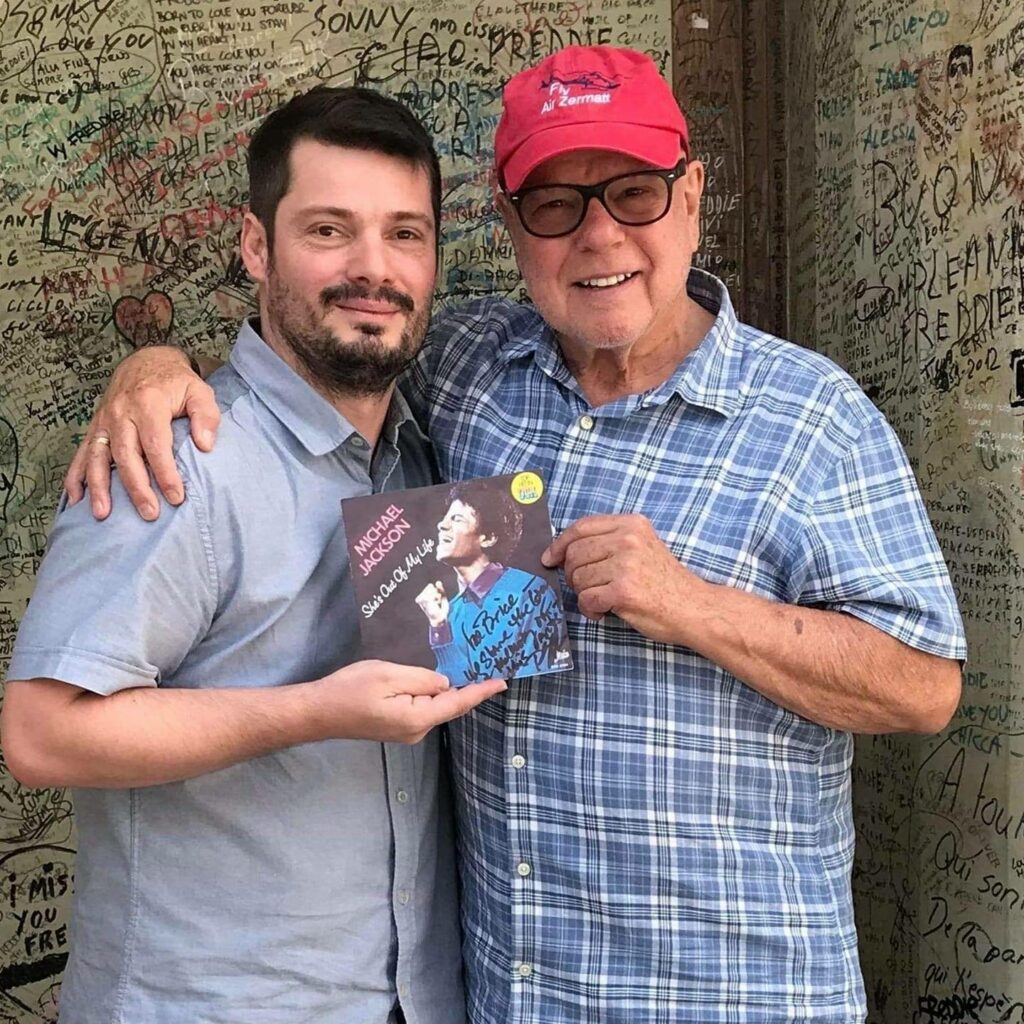
I could only be in awe of this gentleman who had worked for so many artists as a singer, arranger, composer, and producer since the 60s. That first experience reaching out to him had been encouraging, and when I embarked on the Let’s Make HIStory project, the fact that I could count on him was the best way to move past a vital stage: actually starting it. As the author of “She’s Out Of My Life,” he brought total credibility to my endeavor and naturally had much to share about this classic of the Jackson discography. This track was performed on stage from 1981 to 1993 across various tours, and the tradition of the girl coming on stage—much like Eddie Murphy’s earlier parody—contributed to its legend. This deeply autobiographical composition was originally intended to be recorded by Frank Sinatra, but that was without counting on the close friendship and musical bond between Tom Bähler and Quincy Jones. Their connection also began in the 70s; after Quincy sought him out for an initial meeting, having spotted his arranging talents, “Q” was surprised to discover that Tommy was white! From this came the nickname “Nadinola”—a cream meant to lighten the complexion—but the point is that when you receive a nickname from Quincy Jones, it means he is offering you his full affection and friendship. There would have been reason enough to be daunted by turning down an opportunity with Sinatra, especially since Quincy had no specific performer in mind for the song in 1977. However, he wouldn’t remain in suspense for long; his first collaboration with Michael Jackson for The Wiz led them to the Off The Wall album the following year. Thus, “She’s Out Of My Life” helped transition the child star of the Jackson 5 into adulthood. Michael himself called the track “the single,” aware of its potential and likely tied to his own fondness for ballads. That interview with Tom touched on every facet of the creative process, from his personal experience to the moment the song no longer belonged to him, including the studio sessions with all the album’s key players. I didn’t forget to ask him about “Beat It” and his credit in the liner notes related to the Synclavier. One must remember that this innovative instrument cost a fortune at the time! For Quincy, who was always meticulous about budgets and production costs (unlike Michael Jackson a few years later), Tom’s new acquisition was a godsend, and he was able to bring it to the session at Westlake Studios. In fact, it was “Nadinola” who suggested to the company that manufactured the Synclavier that they send the promotional vinyl to Michael Jackson so he could discover its new sounds. That is how the bell sound was added to the intro of “Beat It”—though not without difficulty, as MJ’s perfect pitch wanted to hear that exact sound, down to the finest nuance. However, Tom Bähler’s involvement was not limited to this anecdote. It was he who suggested to Q that they invite the duo Anthony Marinelli and Brian Banks to program synthesizers and provide new textures for the ambitious project that was Thriller. I was satisfied with this exchange with Tom, especially since he also put me in touch with his brother John for another interview. Also a collaborator of MJ since the Motown years, John’s participation in the song “Heal The World” fit perfectly with my book project, and this connection with his brother further deepened our relationship.
The book had been in preparation since the fall of 2014, so you can imagine it was fully on my mind during the summer of 2015 while on vacation. That trip was dedicated to my first journey to American soil, with New York as the destination. A Toto concert had encouraged me to go, though I also knew Tom Bähler was living there at the time. Once we arrived in the land of Uncle Sam, I took the liberty of letting him know we were there, and he invited us for lunch at a restaurant the next day. This was followed by a walk in Central Park and a visit to his apartment, where he played and sang some of his compositions for us. I couldn’t have dreamed of a better start to this first stay in the USA. In this serene and benevolent atmosphere, galvanized by this support (and others taking shape), I realized I would see my project through to the end—there was no other way. This was achieved the following year, at the end of the summer of 2016.
For my next book project dedicated to Blood On The Dance Floor, I might have been tempted not to mention it to Tom since he isn’t credited on that record. For me, that was simply impossible, given that he was such a reassuring and talented figure as an author. To launch into a project again, I appreciated him sharing his experience, and asking him to write the preface seemed like an obvious choice. He kindly accepted, taking the time to follow the book’s progress, even guiding me toward a proofreader for the English version. During our exchanges, the possibility of meeting again was raised. I happened to mention that Quincy Jones attended the Montreux Jazz Festival in Switzerland every year. The setting seemed ideal for a reunion, and it happened in July 2019. He hadn’t even told Quincy he was coming, buying his own concert ticket. He possessed such humility that he didn’t even think to ask for an invitation, even though it would have been entirely legitimate. So, when I saw the setlist a few days before the concert, I noticed that “She’s Out Of My Life” wasn’t on it, despite being performed in London the previous month. I took the liberty of emailing Quincy Jones Productions to mention that the song’s composer would be in attendance. I don’t know if my gesture helped, but when I saw that the British singer Daley had traveled specifically to perform that hit, I was relieved that Tom was there to witness it. That day was memorable; after lunch, we went to take photos in front of the wall of Queen’s Mountain Studios, where Michael had worked on Blood On The Dance Floor. We couldn’t have been more in sync with my current project, following in the footsteps of the King of Pop. This was followed by a visit to the studio—now a museum dedicated to Freddie Mercury and his bandmates—before meeting up after Quincy Jones’ concert at the Stravinski Auditorium, which featured many tracks from the Jackson trilogy. After the show, Tom wanted to find Quincy. It was time to guide him to the lobby of the Fairmont Palace, where Quincy stayed every year, to wait quietly. I have never forgotten the moment their eyes met: time stood still, and I felt like a privileged witness to this reunion between two great men. I didn’t even dare approach Quincy Jones for a signature or a photo; I didn’t want to interfere in a moment that belonged only to them. Covid arrived the following year, and its finest ambassador was never able to return to the festival. I didn’t know it then, but it was the year or never, and Tom sometimes reminded me how happy he was to have come that year, especially since it wouldn’t have been possible afterward.
He always followed what I was doing. When Steve Porcaro came to MJ MusicDay, Tom put me in touch with John Bettis, the lyricist of “Human Nature,” without me even asking. They had worked together for The Carpenters, and it has sometimes been wrongly believed that Tom wrote “She’s Out Of My Life” for Karen Carpenter, one of his past loves. It was around that same time that I reached out to him again for an interview. He was an ideal witness to discuss the 80s and the relationship between Michael and Quincy, in which he had been a key protagonist. This was what I proposed we cover for the new book From Thriller To Bad. However, I had to ask him to recount his memories of “We Are The World.” Indeed, as an associate producer, he had to choose the order and the various voices that would sing on that charity anthem. Around the same time, he participated in the Netflix documentary The Greatest Night In Pop, and I was delighted that a wider audience could hear his words on the subject. I felt the same when he participated in Spike Lee’s 2016 documentary, Michael Jackson’s Journey from Motown to Off The Wall.
We met a third time in the fall of 2024 during a trip to California. We had planned to meet at his home in Santa Ynez, but he was traveling to Los Angeles. He had participated in a conference, along with a few other collaborators, regarding his work with Quincy Jones. We had just arrived, and he was the first person I saw, almost as if it were a custom. This final meeting took place just a few days before Quincy’s death—a moment when one hopes that future departures will be as far off as possible. I often likened Tom to a storyteller with great wit and insight. I didn’t need to pepper him with a vast number of questions; I knew he would always have time for reflection and deep analysis. Beyond his talents as a musician, I would like to add his talents as a writer, as I have read his two books: What You Want Wants You and Anything is Possible. That is why I felt the need to get his perspective on every new project that germinated in my mind. “If you want to do something, then you must do it”—those are words I will never forget. Today, he remains in my thoughts, and I will take the time to discover more works from his rich discography, including his music for films and television. “You must always do things with your heart,” he used to say, and he was so right.